
Website for Beauty Salons: Pages That Turn Clicks to
26 septembre 2026
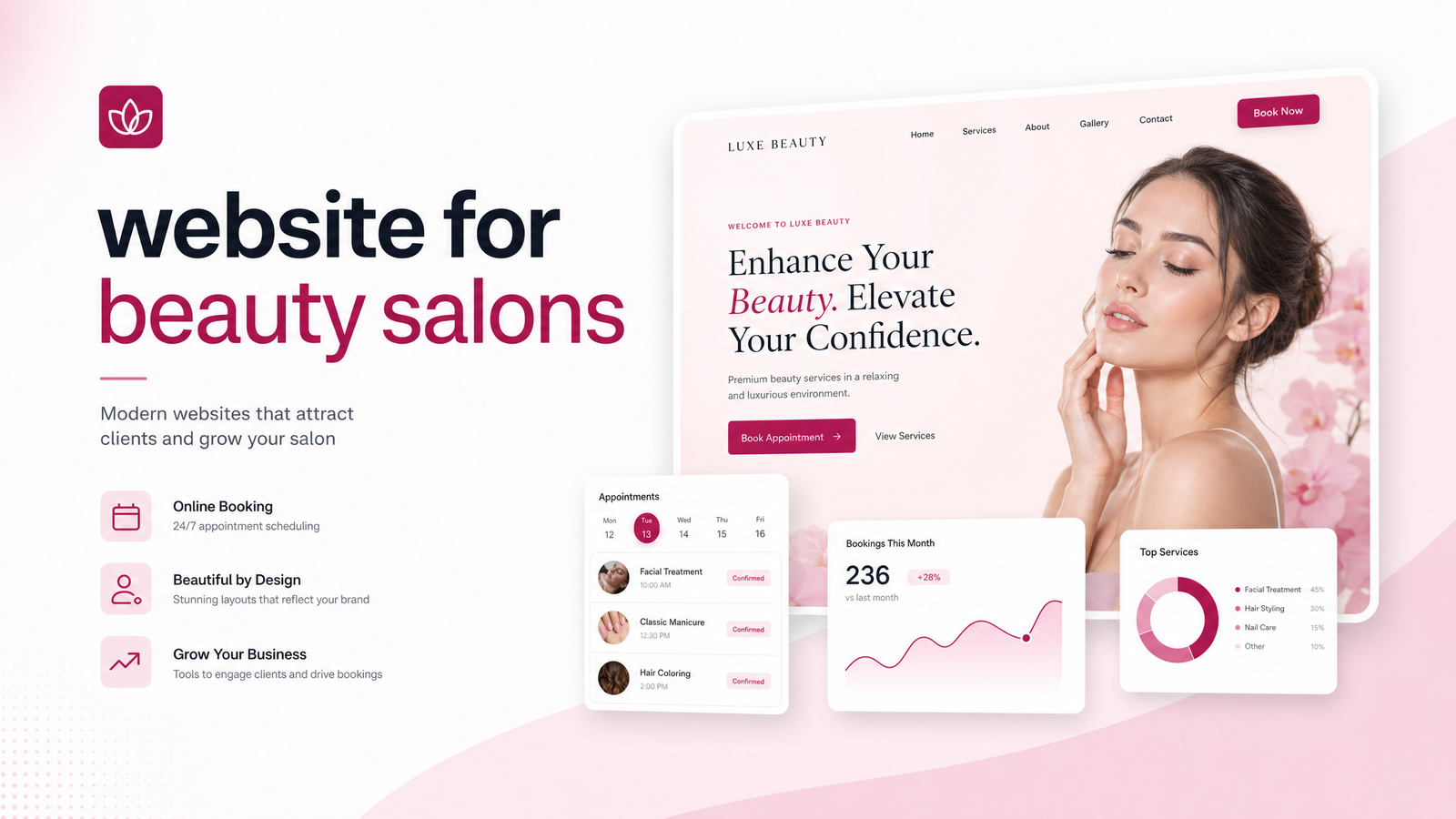
Why a Beauty Salon Website Is Different From 'Just Any' Business Site
A restaurant customer might browse a menu for a week before deciding. A salon client scrolling Instagram at 9:47 p.m., staring at a friend's fresh balayage, wants to book now — or she moves on to whoever makes it easiest. That's salon booking behavior: high emotion, high impulse, almost entirely mobile, and often after hours when your front desk is closed.
A generic small-business template built for a law firm or accounting practice assumes a slower decision cycle and a customer willing to call during business hours. A proper website for beauty salons must remove every point of friction between "I like what I see" and "appointment confirmed," at 11 p.m., on a phone, in under a minute. If your current site can't do that — or you're relying entirely on Instagram and a Google Business Profile listing — you're leaving bookings on the table every night.
The Pages Every Salon Website Needs
Before touching design, audit your site (or brief a designer) against the essential salon website pages. Each has a specific job:
- Homepage — Answer "who are you, what do you do, and how do I book" within seconds of scrolling. Hero image, service highlights, a visible booking button, and a snippet of social proof belong above the fold.
- Services with pricing — Vague menus lose clients. List services in plain language with transparent starting prices; ambiguity about cost is one of the fastest ways to bounce a mobile visitor.
- Stylist/team bios — Clients often book a person, not just a salon. Short bios with a photo and specialty build trust that gets a first-time visitor to pick a stylist instead of abandoning the decision.
- Gallery / before-and-after — Non-negotiable for a beauty business (more below).
- Booking page — Either an embedded widget or a clear link to your existing booking platform, always one tap away from every page.
- Contact and location — Address, map, hours, and phone number, formatted for a thumb, not a mouse.
- Reviews — Pulled from Google or Instagram, ideally synced automatically rather than manually pasted screenshots that go stale.
Nice-to-haves — blog posts, loyalty program details, gift card pages — can come later. These seven determine whether a visitor books or leaves.
Online Booking: The Feature That Makes or Breaks Conversions
This is where most salon websites quietly fail. A beautiful site with a "call to book" button asks a mobile visitor at 10 p.m. to do the one thing she can't do. Salon online booking functionality needs to work like the impulse it's serving: instant, visible, and frictionless.
You've got two real options. The first is embedding your existing booking system — Fresha, Booksy, Vagaro, or Square Appointments — directly into the site, so the calendar loads inline without redirecting the visitor elsewhere. The second is a clean link-out that opens your booking platform in a new tab. Embedding almost always converts better, since every extra tap or page load is a chance for someone to close the browser and book with the salon down the street instead.
When evaluating an embed booking system, look for three things: real-time availability (not "request an appointment and wait for a callback"), clean rendering on a small screen without horizontal scrolling, and syncing with the calendar your stylists already use so there's no double-booking. Since bookings happen around the clock, this single feature does more for revenue than any other page on the site.
Photos, Before-and-Afters, and Reviews: Building Trust Before the First Visit
Beauty services are sold almost entirely on visual and social proof — arguably more than any other local service category. A plumber can rely on a review that says "showed up on time, fixed the leak." A salon client is trusting someone with her hair or skin in a way visible to everyone she knows, so she wants to see the actual work first.
That's why salon before-and-after photos matter so much. Organize the gallery by service (color, cut, lash, skin treatment) rather than dumping every photo into one feed, and keep image quality consistent — natural light, similar angles, no filters that misrepresent the result. Pair it with synced reviews rather than static testimonials; a widget pulling live from Google keeps the page current without manual updates and reinforces the trust signals a visitor already saw on your Google Business Profile or Instagram before clicking through.
Salons offering spa-adjacent services — facials, massage, skin treatments — face a slightly different trust dynamic, leaning more on calm, sensory presentation than dramatic transformation shots. If that's closer to your business, this piece on website design for spas and massage therapists is worth a look for comparison.
Getting Found: Local SEO Basics for Salons
Most "beauty salon near me" searches happen on a phone, often triggered by the same impulse we opened with — someone sees a look they want and searches immediately. Salon local SEO starts with the basics: a fully completed Google Business Profile, consistent name/address/phone details across your site and directories, service pages using terms clients actually search (not internal jargon), and a fast, mobile-friendly site, since page speed and mobile usability are ranking factors Google weighs directly.
A website also gives you something a Google Business Profile alone can't: pages Google can index and rank for individual services, neighborhoods, and long-tail searches. For deeper mechanics of local visibility — citations, map pack factors, and what to fix after launch — see this dedicated resource on local SEO for small business websites.
DIY Builder, Freelancer, or Done-For-You: Choosing Your Path
Most owners weigh three routes. A DIY salon website builder is cheapest upfront but demands time you probably don't have — writing service copy, sourcing and editing photos, configuring a booking embed correctly, and keeping it updated between client appointments. A freelancer costs more and removes the design work, but you're still managing revisions, briefing SEO, and hoping they understand booking-flow nuance for salons specifically. A done-for-you service builds the site, writes the copy, sets up the booking integration, and handles the SEO groundwork as one package — the least time-cost option for an owner already running a full appointment book.
If you're client-facing and appointment-driven, the comparable service page to look at is websites for clinics, consultants and practices, which covers the same booking-first approach adapted for salons.
Frequently Asked Questions
Do I still need a website if my salon already uses Instagram and a booking app like Fresha or Booksy?
Yes — Instagram and booking apps show your work and let existing followers book, but they don't rank in Google search, don't control your branding, and can't host service pages or before-and-after galleries the way a website can. A website captures new clients searching Google who've never followed you on Instagram, and keeps your booking, pricing, and reviews in one place you fully control.
How much does a website for a beauty salon cost?
Costs vary widely based on scope, number of pages, and whether booking integration and copywriting are included. See this detailed guide on small business website costs in 2026 for realistic ranges.
What should be on a beauty salon homepage?
At minimum: a clear hero section stating what you offer, a visible booking button, service highlights, a taste of your before-and-after gallery, and a snippet of reviews. Everything above the fold should let a mobile visitor understand your salon and find the booking button within seconds.
Can I embed my existing booking system into a new website?
In most cases yes — platforms like Fresha, Booksy, Vagaro, and Square Appointments offer embeddable widgets or booking links a new site can incorporate directly. This avoids re-training staff on a new system and keeps client history intact while improving how the booking flow looks and performs on mobile.
How long does it take to launch a beauty salon website?
Timelines depend on how much content (photos, service copy, pricing) is ready going in, but a done-for-you build typically moves faster than DIY because design, copywriting, and booking setup happen in parallel rather than one owner handling every step solo.
Does a salon website actually help with Google rankings, or is a Google Business Profile enough?
A Google Business Profile alone can't rank for individual service or location-based searches the way indexed website pages can. A website gives you dedicated pages for services, locations, and long-tail search terms, working alongside your Business Profile rather than replacing it.
Ready to see it built for you? Launchevra designs done-for-you salon websites — design, copywriting, booking integration, and SEO handled as one project. Check the service page for appointment-based businesses or head straight to pricing to see packages and get started.
Publié à l'origine sur Rankevra.