
Google Business Profile vs Website: Which Do You Need?
30 septembre 2026
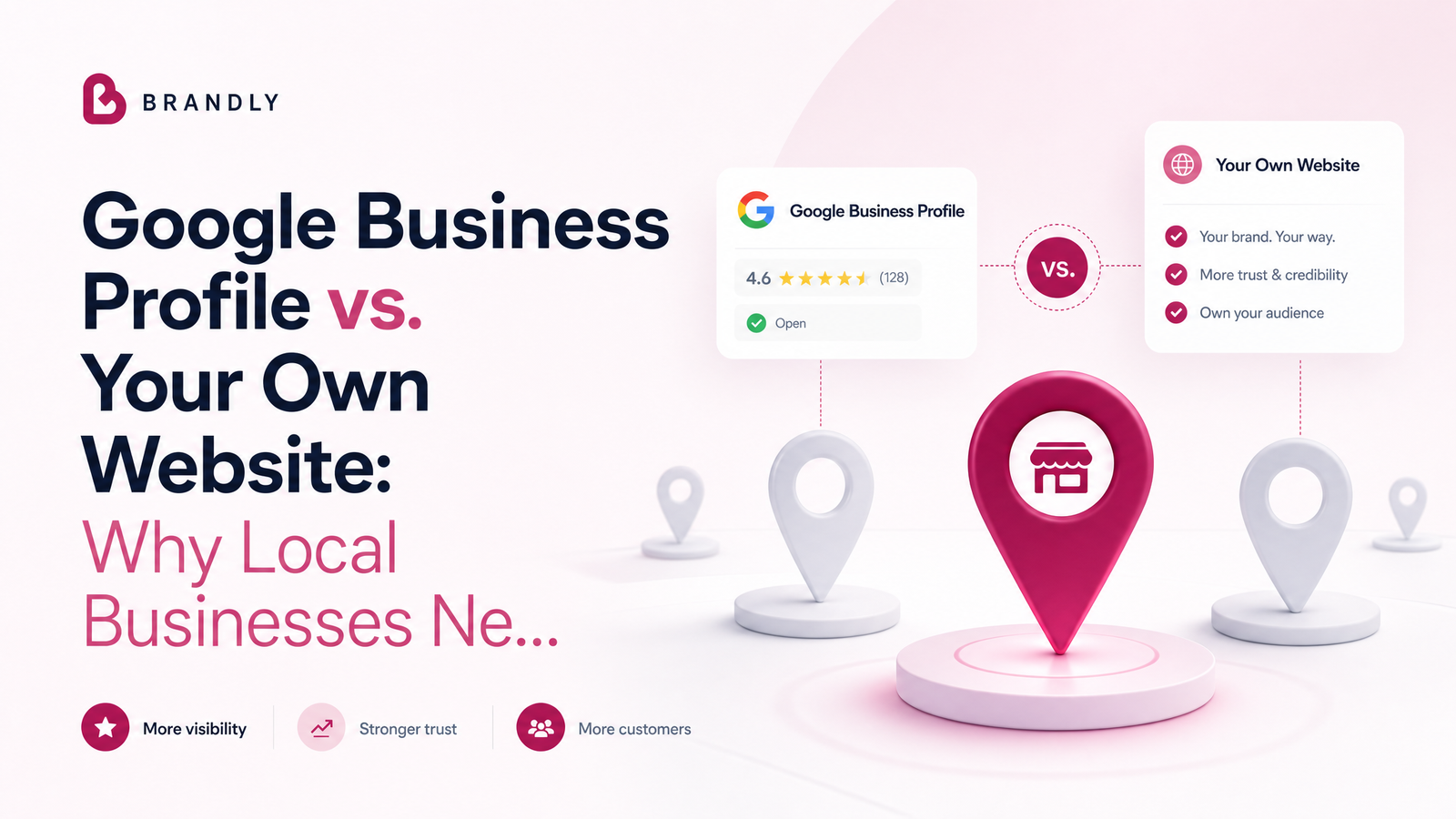
Most local business owners eventually ask the same question: Google Business Profile vs website — do I really need both? The honest answer is that they're a division of labor. In 2026, Google Business Profile signals drive roughly a third of local pack rankings, while on-page website signals drive local organic rankings — skip either one, and you cap how visible and how convincing your business can be.
The Real Difference Between a Google Business Profile and a Website
A Google Business Profile (GBP) is a free, Google-hosted listing showing your name, address, and phone number (NAP), hours, photos, and reviews, and it plugs directly into Google Maps and the local pack. You don't own it — Google does — and you're working within a template you can't redesign.
A business website is a property you actually own. It can carry service pages, pricing, portfolios, case studies, and a story that goes far beyond what a listing card allows. It's built to persuade, not just to inform.
The simplest way to picture it: your GBP is the storefront sign that gets noticed on a busy street. Your website is the salesperson inside, ready to answer questions, show product, and close the deal. One earns the glance; the other earns the commitment.
What Each One Does That the Other Can't
Google Business Profile wins:
- Map pack placement — the three listings shown above organic results for "near me" and location-based searches
- Instant trust signals: star ratings, review count, and hours visible without a click
- Zero technical skill required to set up or maintain
Website wins:
- Ranking in local organic (non-map) search results, where GBP has no direct authority
- Full control over messaging, pricing, and portfolio depth
- Independence — no risk of suspension, no algorithm reshuffling your listing template overnight, no reliance on Google's roadmap
This is one of the clearest GBP limitations: it cannot rank you in the regular organic results beneath the map pack. Those rankings run on classic on-page SEO — content, site structure, schema markup, and backlinks — none of which a listing can substitute for. BrightLocal's breakdown of Google's local algorithm confirms this split: GBP signals dominate the map pack, while website signals dominate organic. That's why you need a website, not just Google, if you want to show up more than once on the results page.
What Happens If You Only Have One
GBP-only businesses look unverified to careful buyers. A prospect who clicks through expecting a real site and finds nothing — or a dead link — quietly moves to a competitor who looks more established. You also have zero organic footprint; anyone searching outside map-triggered queries won't find you. And you're fully dependent on a platform you don't control — a profile suspension, guideline change, or review-bombing incident can knock out your only channel overnight.
Website-only businesses miss the map pack entirely, losing the free, high-intent visibility that local searchers rely on most. You also forfeit the review volume and star-rating trust signal that GBP surfaces before a single click happens. So "do I need a website if I have a Google Business Profile" and "do I need a GBP if I have a website" have the same answer: yes, each fills a gap the other can't. Localo's analysis of over 16,000 Google Business Profiles found that having a linked website is near-universal among top-ranked profiles, not a nice-to-have.
How to Make Them Work Together
Once you accept both are necessary, the goal shifts to integration:
- Link the website URL in your GBP — and don't just point it at your homepage. Send clicks to the page that matches the search intent: a specific service page, location page, or contact page with a clear call to action.
- Match NAP exactly across both. NAP consistency — identical name, address, and phone formatting on your GBP and your website footer or contact page — is a trust signal Google and directories cross-reference. Inconsistent NAP is one of the most common, and most fixable, local SEO errors.
- Make sure the landing page is fast and relevant. A GBP click that lands on a slow, generic homepage wastes the visibility you worked to earn. Whitespark's 2026 Local Search Ranking Factors Report consistently ranks on-page relevance and site performance among the top drivers of local organic visibility.
- Mirror your service descriptions in both places so a searcher sees continuity, not contradiction, between the listing and the site.
- Use the website to capture and display reviews, reinforcing the star ratings a visitor already saw on your GBP before they clicked.
Structured data helps here too — schema markup on your website (LocalBusiness, service, and review schema) gives Google explicit confirmation that the entity behind the site and the entity behind the GBP are one and the same. Pair that with regular checks in Google Search Console to catch indexing or crawl issues before they quietly suppress your organic rankings.
Quick Answer: So Which One Should You Build First?
Set up your Google Business Profile immediately — it's free, fast, and gets you into the local ecosystem within days. But don't treat the website as a someday project. GBP sends the clicks; the website has to convert them, and every day without one is a day those clicks land nowhere or land on a competitor by comparison. If you're weighing which comes first, website or Google Business Profile, the real answer is: GBP first by hours, website second by days — not months.
If cost is what's holding you back, this breakdown of small business website pricing in 2026 is worth reading before you decide to wait any longer.
Frequently Asked Questions
Do I need a website if I already have a Google Business Profile?
Yes. A GBP alone can't rank you in organic search results, can't showcase full pricing or portfolio depth, and offers no protection against platform changes or suspensions. It gets you noticed; a website is what earns the trust and information a serious buyer needs before contacting you.
Can a Google Business Profile replace a website completely?
No. GBP is a listing template controlled by Google, not a property you own, and it has no ability to rank in local organic search results. It works well for map pack visibility and instant trust signals, but it can't hold service pages, detailed pricing, or a persuasive brand story the way a website can.
Does having a website help my Google Business Profile rank higher?
Yes, indirectly. Google cross-references your website's content, NAP consistency, and schema markup as part of confirming your business's legitimacy and relevance, and a fast, well-optimized landing page improves the outcome once a GBP click happens. Profiles linked to real websites are also far more common among top-ranked listings than unlinked ones.
What should I link in the website field of my Google Business Profile?
Link to the most relevant landing page for what searchers are looking for — often a specific service or location page — rather than defaulting to your homepage. That page should load quickly and directly answer the intent behind the search that triggered the click.
Is it bad for local SEO if my website and Google Business Profile show different information?
Yes. Inconsistent NAP (name, address, phone) or mismatched service descriptions between your GBP and website undermine the trust signals Google uses to confirm your business is legitimate and accurately represented. Keep both sources identical to avoid weakening your local rankings.
How much does it cost to get a website if I only have a Google listing right now?
Costs vary depending on scope, but there's a full breakdown of realistic 2026 pricing in this small business website cost guide. The short version: a properly built site is a one-time investment that compounds every month it's live, unlike ad spend that stops working the moment you stop paying.
Ready to build the half of the equation that actually converts your GBP clicks? Launchevra builds fast, schema-ready websites for contractors and trades and clinics, consultants, and professional practices — designed specifically to receive local search traffic and turn it into calls and bookings. Check pricing to get started.
Publié à l'origine sur Rankevra.