
Website Design for Spas and Massage Therapists That Converts
25 September 2026
Why Spa and Massage Websites Fail to Convert (Even With Traffic)
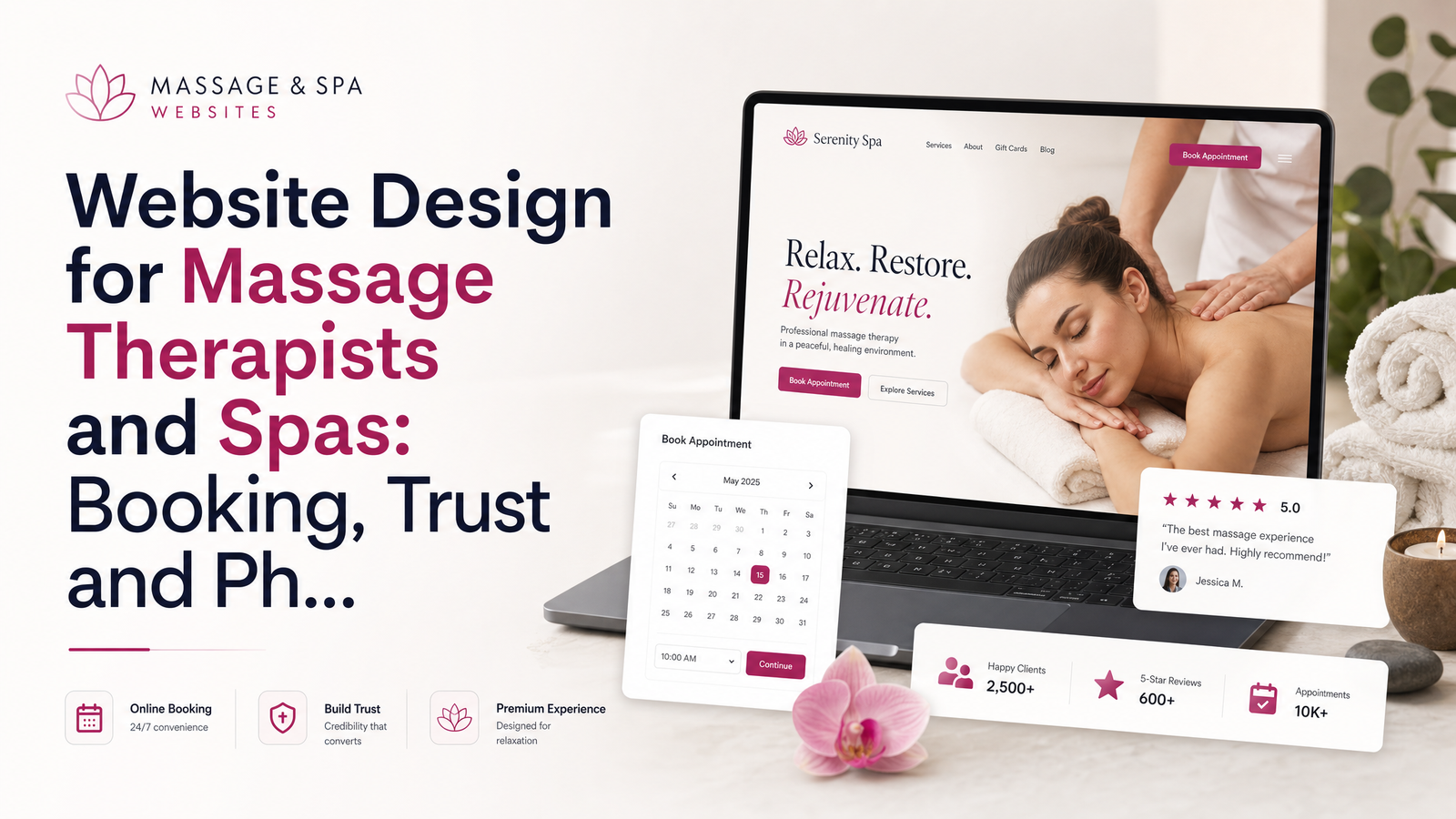
A spa or massage practice can rank on Google, run ads, and still watch visitors leave without booking. That's usually a design problem, not a marketing one. Good website design for spas and massage therapists has to solve three friction points specific to hands-on wellness businesses: booking behavior split between online and phone, trust that's harder to earn for a service delivered in a private room, and photography that either shows the real experience or makes the business look like every other stock-photo spa. Here's how to fix each one, and what a self-audit looks like before you commit to a redesign.
Booking: Design for the Way Clients Actually Book
Massage and spa clients don't behave like restaurant or retail customers. A meaningful share still prefer to call, text, or rebook in person at checkout rather than use an online form — Mangomint's research on massage booking behavior confirms phone and in-person rebooking remain heavily used alongside online scheduling, not replaced by it. A site built as an app-only funnel, where the only path to an appointment is a buried "Book Now" button linking to a separate platform, quietly loses the callers and walk-in rebookers who never fully migrate to self-service.
The fix is a dual-path layout: a visible spa website booking system embedded above the fold, next to a click-to-call phone number in equally prominent type — not hidden in a footer. For returning clients, a "rebook your last service" link or a direct line to the front desk reduces the friction of navigating a full booking flow for something they've done ten times before.
Mobile matters even more here. Zenoti's 2025 spa consumer trends report points to a strong, growing preference for booking on a phone rather than desktop, so online booking for massage business sites needs a widget that renders cleanly on small screens — no horizontal scrolling, no tiny date pickers, no forms that require zooming. List service durations and price ranges plainly next to each option; ambiguity about how long a 90-minute deep tissue session actually costs is a common reason people abandon a booking form mid-flow.
Trust: Why a Hands-On, Private Service Needs More Proof
Booking a massage means inviting a stranger to touch you in a closed room — a categorically different trust decision than buying a product online, and the website has to do more work to earn it. This is where trust signals for spa websites matter most, and where most sites say too little.
Start with licensing and certification. A massage therapist credentials website should display state license numbers, professional certifications, and years of practice clearly, not buried in an "About" paragraph. Pair that with real therapist bios — training background, specialties, and a professional photo — so a visitor isn't booking with an anonymous name. Cleanliness and safety policies (linen changes, sanitization between clients, intake forms) reassure first-time visitors unfamiliar with what happens behind the treatment room door. Clear intake and consent information, posted before the appointment rather than sprung on someone at check-in, removes a real source of hesitation for new clients.
Reviews close the loop. Pulling real star ratings and review snippets directly onto the site — rather than making visitors hunt for them on a third-party platform — reinforces everything above with independent proof. If reviews live on your Google Business Profile, it's worth getting that listing fully optimized first; see this guide to setting up a Google Business Profile for the details. Accessibility belongs in this same trust bucket: alt text on images and captioned video aren't just compliance checkboxes, they're explicitly part of ADA design guidance for treatment spaces, and a site readable by screen readers signals the same care a client expects in the treatment room itself.
Photos That Sell the Experience (Not Stock Serenity)
Generic images of candles, bamboo, and stacked stones are the fastest way to make a spa site look interchangeable with every competitor's. Visitors have seen these photos a hundred times, and they communicate nothing about your actual space, staff, or what a session with you feels like. Real spa website photography tips start with a simple principle: show what's actually there.
A practical shot list: the real treatment room, lit well and shown from the angle a client would first see it; the therapist at work (with client consent and, if needed, a model release), which builds confidence more than any stock image ever will; facility shots of amenities like a sauna, quiet room, or reception area; an exterior or signage photo so first-time visitors can recognize the building from the street or a parking lot. Across the best massage therapy website examples, this authenticity is the consistent thread — sites that look like a specific place run by specific people, not a wellness template. Every image also needs to be compressed and sized for mobile; a beautiful photo that takes four seconds to load on a phone works against the booking widget sitting next to it.
A Quick Self-Audit Before You Redesign
Run through this spa website design checklist in under five minutes:
- Is a booking widget visible without scrolling, next to a clickable phone number?
- Does the booking flow show service durations and prices before requiring an account?
- Are licenses, certifications, and therapist bios easy to find?
- Are cleanliness policies and intake/consent info posted somewhere visible?
- Do real reviews and star ratings appear on the site itself, not just off-site?
- Are the photos actual images of your space and staff, not stock library results?
- Does the site load quickly and display cleanly on a phone?
If more than two of these are weak, the issue isn't traffic — it's what happens after someone arrives.
Getting It Built Without Doing It Yourself
Fixing all three friction points — choosing and configuring a booking system, art-directing a photoshoot, writing trust and credential copy that doesn't sound generic — is a lot to take on alongside running appointments. Launchevra builds this as a done-for-you package for spas, clinics, and independent practitioners: the booking widget, the trust architecture, and the photography direction handled as one system rather than three separate projects. Take a look at Websites for clinics, consultants and practices to see how it's structured, and check Pricing for current packages.
You shouldn't have to become a web designer, a photographer, or a copywriter to get a site that actually books appointments. Launchevra handles the booking-widget selection, the photography direction, and the trust-page copy so the finished site is ready to convert from day one.
Frequently Asked Questions
Do I need a separate booking app if I already have a website?
No — the booking widget should live directly on your website rather than requiring a separate app download. What matters is that it's visible above the fold and paired with a prominent phone number, since many massage clients still prefer calling or rebooking in person over using self-service tools.
How many photos does a massage or spa website actually need?
Most sites need somewhere between 10 and 20 well-chosen images: the treatment room, therapist at work, facility/amenity shots, an exterior shot, and a few detail images, rather than dozens of generic stock photos. Quality and authenticity matter far more than volume here.
Is it worth paying a photographer instead of using stock photos?
Yes — stock photos of candles and stones look identical across competitor sites and build no trust in your specific space or staff. A short, focused photoshoot of your actual treatment room and therapists (with consent) does more to convert visitors than a large library of generic wellness images.
What licensing or credential information should a massage therapist show on their website?
State license numbers, relevant certifications, years of experience, and a therapist bio should all be clearly visible, not buried in an about-page paragraph. This information reassures first-time clients that they're booking with a verified, qualified professional for an in-person, physical-touch service.
Does my spa website need to be ADA accessible?
Yes — accessibility considerations like image alt text and captioned video are an explicit part of ADA design guidance for massage and treatment spaces, not just a nice-to-have. An accessible site also reinforces the same standard of care clients expect during an in-person visit.
How much does a professionally designed spa or massage website cost?
Costs vary depending on scope — booking integration, photography, and copywriting all affect the final price. Launchevra's current packages and pricing tiers are listed on the Pricing page so you can compare options before reaching out.
Originally published on Rankevra.