
Website Design for Veterinary Clinics: What Converts
21 September 2026
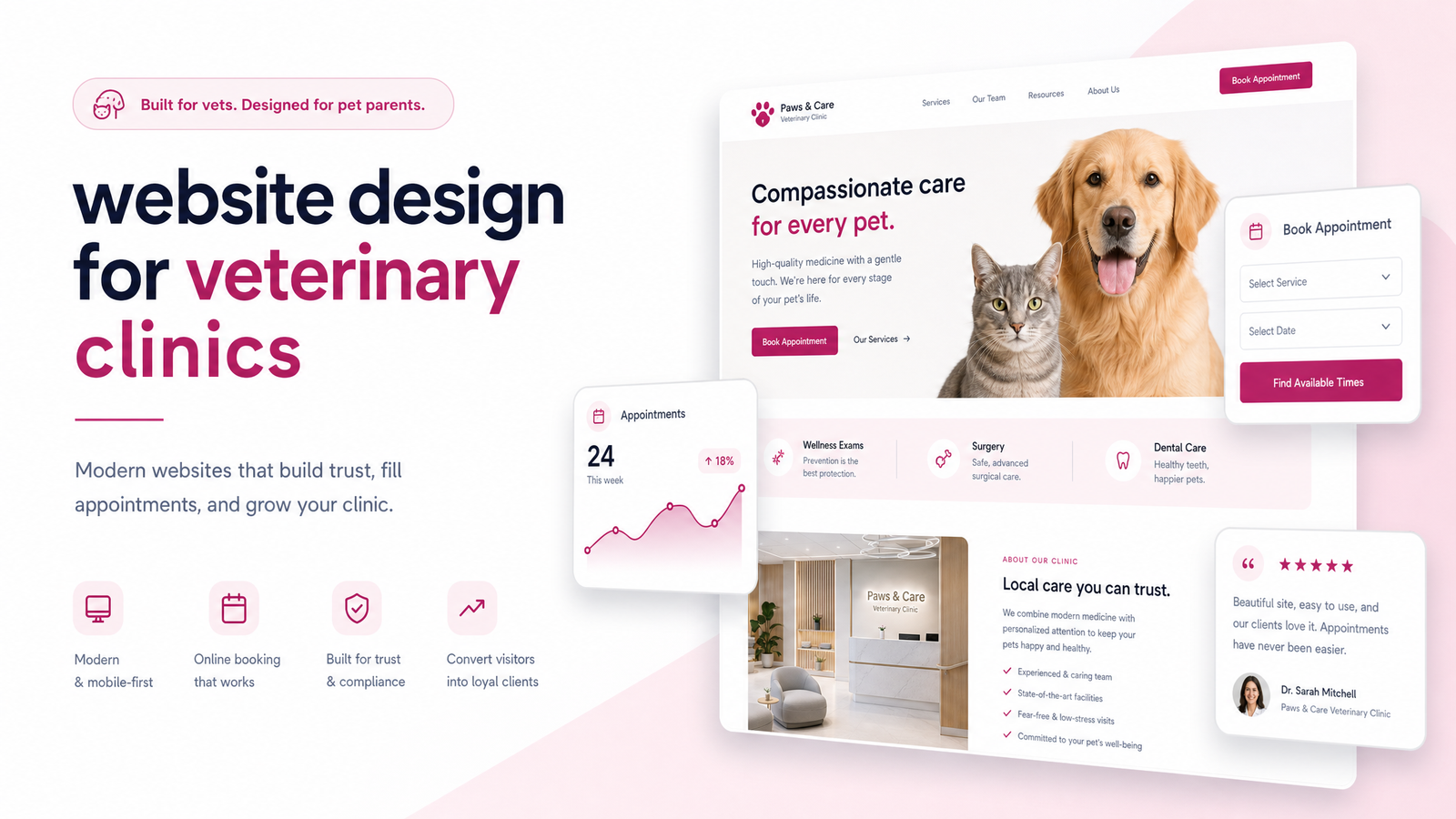
Why a Veterinary Website Isn't Just a Digital Brochure
A pet owner searching for a vet at 9 p.m. isn't browsing — they're triaging. Their dog won't stop shaking, their cat hasn't eaten in two days, and they're doing it all one-thumbed on a phone while trying to keep the animal calm. That's the real context most website design for veterinary clinics has to serve, and it's why treating a clinic site like a pretty digital brochure misses the point.
Behavior backs this up. Most pet owners research a practice online before ever calling, according to PetDesk's pet-owner statistics — meaning your homepage often does the work a receptionist used to do. Web Tonic's veterinary landing page data shows click-to-call is one of the highest-value actions on a vet site, and after-hours inquiries make up a meaningful share of traffic — people seeking emergency guidance or trying to book before the clinic reopens.
Together, these facts mean a veterinary website's job is to get a stressed, mobile visitor to a phone call or booked appointment as fast as possible. Every design decision — layout, load speed, navigation — either shortens that path or adds friction that sends the visitor to the next search result. The frame for this guide isn't "does it look modern," but "does it get the appointment."
The Must-Have Features of a High-Converting Vet Clinic Website
A strong veterinary website features list is short, but every item earns its place by removing a specific point of friction.
- Click-to-call locked into the mobile nav. The phone number should be tappable from every page, not buried in a footer — the single highest-leverage element on the site.
- Hours and emergency info above the fold. Pet owners need to know instantly whether you're open, and if not, where to go. Bury this and they bounce to a competitor.
- Online booking widget. Tools like PetDesk or Vetstoria let owners request appointments without waiting for a callback — increasingly expected, especially for routine wellness visits. If you're unsure which booking system fits your clinic, this decision guide on online booking for service businesses breaks down the tradeoffs.
- Service pages organized by category — wellness, surgery, dental, emergency — so search engines and pet owners can find the specific service they need instead of one undifferentiated page.
- Accreditation and certification badges. AAHA accreditation, Fear Free Certified Professional status, and Cat Friendly Practice designation all signal trust, and belong near the top of the homepage, not hidden on an "About" page.
- Live or recent Google reviews. Pulling in your Google Business Profile reviews gives new visitors third-party proof without leaving the site.
Any vet website builder or platform you choose should make these features easy to prioritize — not just possible, but front and center. A site that technically has online booking, buried three clicks deep on a desktop-only layout, isn't really offering online booking for veterinary clinics at all.
3 Mistakes That Quietly Cost Vet Clinics New Patients
Slow-loading mobile pages. Google's Core Web Vitals measure exactly what pet owners feel: how fast a page becomes usable. A site stuffed with oversized homepage images or an old plugin-heavy template often fails these benchmarks, and slow load times correlate directly with visitors abandoning before the page even renders — a lost appointment before anyone sees your hours. Vet website mobile speed isn't a technical nice-to-have; it's the difference between a call and a bounce.
Buried phone numbers and hours. If a clinic's contact info is only in a footer graphic or a PDF, mobile visitors will leave rather than hunt for it. This is one of the most common — and most fixable — veterinary website design mistakes, and it disproportionately affects the after-hours, high-urgency visitors this guide is built around.
No way to capture after-hours or emergency inquiries. If your clinic is closed and there's no clear next step — an emergency partner link, an after-hours form, a clear message about where to go — visitors leave with nothing, and remember that gap the next time they need a vet. If you suspect your current site is losing visitors this way, this 15-minute lead-generation diagnostic is a fast way to find out where.
DIY, Template, or Custom Build: What Fits Your Clinic?
There's no single right answer — it depends on your size, competition, and how much time you actually have.
DIY builders make sense for a single-doctor practice on a tight budget with genuinely simple needs — one location, one set of hours, no complex service lines. The tradeoff is time: building it yourself, learning the platform, and maintaining it as your practice grows all fall on you.
Templates suit clinics that need something functional live quickly and don't mind looking similar to other practices nearby. They're faster and cheaper than custom builds but offer less room to differentiate service pages, badges, or booking flows around how your clinic actually operates.
A custom-built site is the better fit for multi-provider practices or clinics competing in a crowded local market where nearby competitors already look professional online. Custom builds cost more upfront, but let every element — accreditation placement, service categorization, booking integration — be built around your actual patient flow rather than a generic mold. This is also where a done-for-you approach pays off: a site built around veterinary-specific behavior without spending your own hours on layout decisions or copywriting. For clinics that want copy that builds trust rather than generic filler text, this framework for clinic website copy covers the messaging side this article intentionally leaves aside. LaunchEvra's websites for clinics, consultants, and practices service is built around exactly this custom path.
Frequently Asked Questions
How much does a website for a veterinary clinic typically cost?
Cost varies by build type: DIY builders can run near-zero beyond a subscription fee, templates typically land in a moderate one-time or monthly range, and custom-built sites cost more upfront but are scoped to your clinic's specific services and provider count. Check current pricing for a done-for-you custom build.
Do I really need online booking, or is a phone number enough?
A phone number alone leaves a real gap, since after-hours and routine wellness bookings increasingly happen online before a call is ever made. Online booking doesn't replace your phone line — it captures visitors who'd rather not call at all, particularly for non-urgent scheduling.
What should be on the homepage of a veterinary clinic website?
Click-to-call, current hours, emergency guidance, and a booking link should all be visible without scrolling. Below that, service categories, accreditation badges (AAHA, Fear Free, Cat Friendly), and recent Google reviews build the trust needed to convert a first-time visitor into a call or booking.
Can I use a generic website template for my vet clinic, or does it need to be custom?
A generic template can work for a small, simple practice that mainly needs a functional online presence fast. Clinics with multiple providers, several service lines, or real local competition generally see better results from a custom build tailored to how pet owners actually search and book.
How long does it take to get a new veterinary clinic website live?
Timelines depend on build type — a DIY or template site can go live in days, while a custom veterinary website typically takes several weeks once content, service pages, and booking integrations are properly built and tested. Done-for-you builds shift most of that time burden off the clinic owner.
Does my veterinary website need to meet accessibility (ADA) standards?
Yes — ADA Title III web accessibility applies to businesses serving the public, including veterinary clinics, and non-compliant sites carry both legal risk and usability problems for visitors using screen readers or other assistive tools. Building with accessibility in mind from the start is far simpler than retrofitting it later.
If your current site is costing you calls instead of winning them, you don't have to become a web designer to fix it. LaunchEvra builds veterinary and clinic websites done-for-you, so you can stay focused on patients while we handle the site — see how it works on the clinics and practices page or check pricing to get started.
Originally published on Rankevra.