
Cost to Create a Website for a Small Business (2026 Guide)
26 September 2026
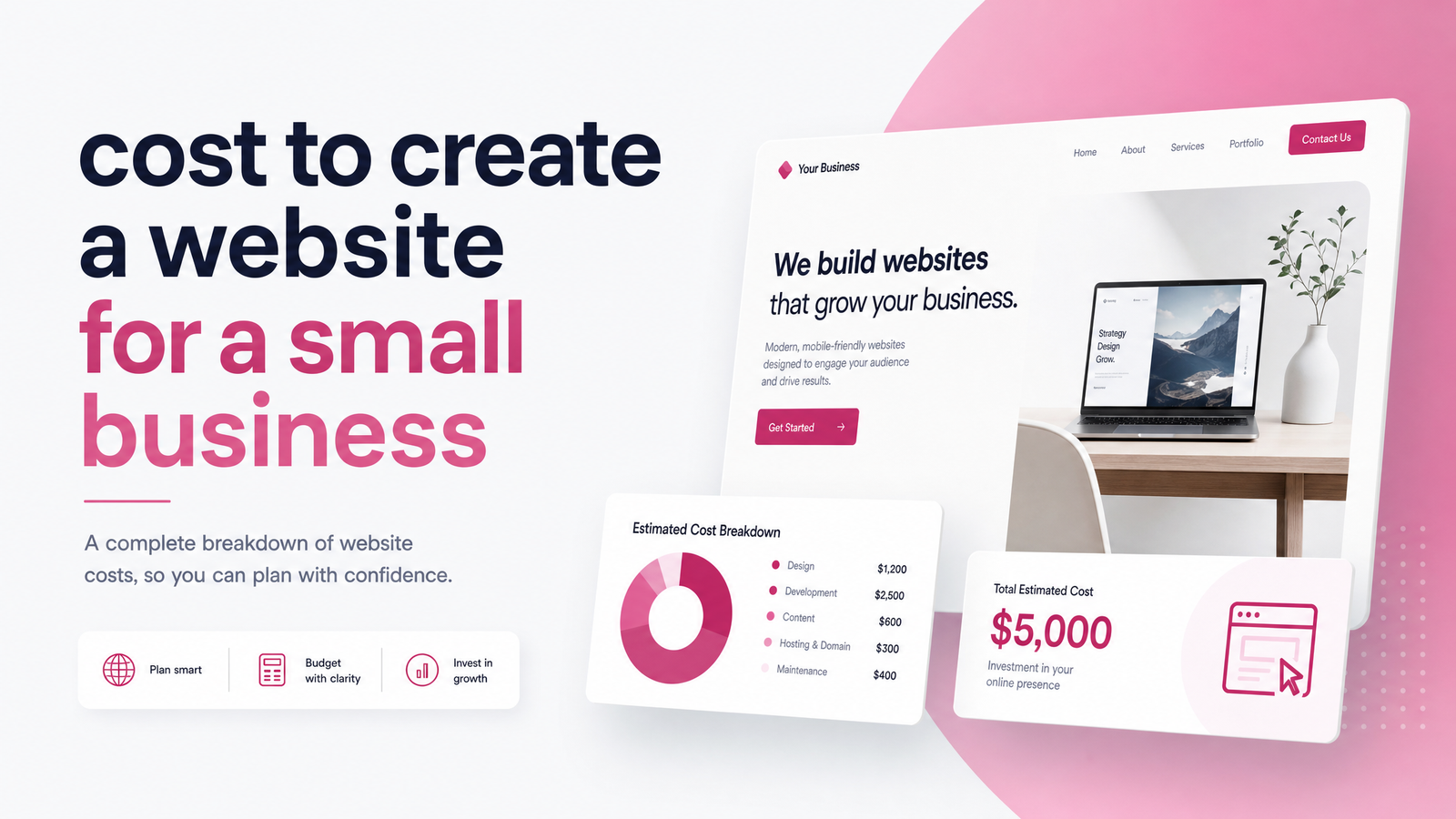
Ask five business owners what they paid for their website and you'll get five wildly different answers — $200, $800, $4,000, $20,000. That gap exists because the cost to create a website for a small business isn't one number. It's a decision with four different paths, each trading time, money, and quality against each other. Understanding that framework, rather than chasing a single "average price," is what lets you budget with confidence.
What Actually Determines the Cost of Creating a Website
Every website, regardless of who builds it, is made of four cost layers:
- Build — the design, layout, and development work to get pages live
- Infrastructure — domain registration, hosting, and an SSL certificate
- Content — copywriting, photography, and any videos or graphics
- Growth and maintenance — SEO setup, ongoing updates, backups, and post-launch fixes
Most price comparisons only quote the build layer, which is why a $500 freelancer quote and a $15,000 agency quote can both look "reasonable" in isolation. The real website cost factors are how many of these four layers are included, and how much work you're expected to do yourself. Keep that in mind as you read the ranges below — it's the difference between a fair quote and a surprise invoice.
The 4 Ways to Create a Small Business Website (And What Each Really Costs)
There are really only four routes to a live website, each sitting at a different point on the time-versus-money spectrum.
DIY Website Builder
Using a platform like Wix, Squarespace, or WordPress typically runs $150–$600 for the first year, counting the template, a paid plan, and a domain. This is the cheapest entry point, but the DIY small business website cost is deceptive — the sticker price doesn't include the dozens of hours you'll spend choosing a theme, writing copy, resizing images, and troubleshooting settings you've never touched before. You get full control and low upfront spend, at the cost of your own time and a design that often looks templated.
Freelance Designer or Developer
Hiring an independent designer or developer usually costs $500–$5,000 depending on experience and scope, with WordPress and Webflow being common platforms. This freelancer website cost buys real design skill and some customization, but quality varies enormously between freelancers, timelines can slip, and ongoing support after launch is rarely included unless negotiated upfront — exactly why a clear scope document matters before you sign anything.
Web Design Agency
A full-service agency typically charges $3,000–$20,000+, covering strategy, custom design, copywriting, and sometimes SEO. This buys polish, brand strategy, and a dedicated team, but it's overkill for many small operators — a solo contractor or single-location clinic rarely needs the same scope as a multi-location franchise, and agency timelines often stretch to months.
Done-For-You Service (like Launchevra)
A done-for-you website service sits between freelancer and agency pricing, usually $1,000–$5,000 for a fixed package that includes design, copywriting, basic SEO setup, and launch support — no back-and-forth hourly billing. This model works because it's productized: you're not paying for a stranger's learning curve or an agency's overhead, just a defined outcome. For a direct comparison against DIY and freelancer numbers, Launchevra's Pricing page lays out fixed packages rather than vague estimates.
For the full granular price tables behind these ranges, see How Much Does a Small Business Website Cost in 2026?
The Hidden Costs Most Quotes Leave Out
The build price is rarely the total price. Domain registration runs $10–$20/year, hosting $100–$500/year, and an SSL certificate is often bundled free with modern hosts but should be confirmed. Copywriting, if not included, can add $200–$1,500 depending on page count, and stock or custom photography adds more. Then there's the ongoing website maintenance cost — updates, backups, security patches, and small content changes — which typically runs $600–$6,000/year depending on how actively the site needs attention. A widely used rule of thumb is to budget an extra 10–20% of your build cost annually for these ongoing costs. Skipping this step is the single biggest reason owners feel blindsided a year after launch.
Don't Forget the Cost of Your Own Time
The "free" appeal of DIY builders ignores the real time cost of building your own website. Between choosing a template, writing every page, sourcing images, learning the platform's quirks, and fixing mistakes, most owners spend 20–40 hours on a genuinely usable site — often more if they're perfectionists or juggling it around client work. If your time is worth even $40/hour, that's $800–$1,600 of unpaid labor hidden inside a "$200 website." For a busy contractor or clinic owner, that math often makes a modest paid option cheaper than it first appears.
How Much Should You Actually Budget?
Match your budget to what the site needs to do rather than picking a number off a generic table. A contractor needing quote requests and local visibility can often succeed with a $1,000–$3,000 done-for-you build focused on lead generation — see Websites for contractors and trades for examples. A clinic or consultant selling trust and credibility typically needs stronger copywriting and a booking-friendly layout, landing in the $2,000–$5,000 range — Websites for clinics, consultants and practices shows what that looks like in practice. Retail or e-commerce shops using Shopify usually need higher budgets due to product catalog work. Whatever route you choose, use a Website Design Contract Checklist for Small Business Owners to confirm any freelancer or agency quote actually matches the scope you think you're paying for.
Frequently Asked Questions
Is it cheaper to build my own website or hire someone?
DIY is cheaper in dollars but not in time — a basic builder site costs $150–$600 but consumes 20–40+ hours of unpaid work. Valuing that time at even a modest hourly rate, a fixed-price done-for-you service often costs about the same or less for a better result.
How much should a small business realistically budget for a new website in 2026?
Most small businesses should budget $1,000–$5,000 for a professional site with design, copywriting, and basic SEO included, plus 10–20% of that annually for hosting and maintenance. Agencies run higher ($3,000–$20,000+), while pure DIY builds sit at $150–$600 plus your own time.
What ongoing costs come after the website is built?
Expect domain renewal (~$10–$20/year), hosting ($100–$500/year), and maintenance or updates ($600–$6,000/year depending on activity level). These recurring costs are often left out of build quotes, which is why total cost of ownership matters more than the launch price alone.
Can I get a professional website for under $1,000?
Yes, but options narrow to entry-level DIY builds or smaller freelancer projects, and you'll likely handle copywriting and image sourcing yourself. Done-for-you packages near this range typically cover fewer pages or lighter SEO setup than higher-tier packages.
What's included in a 'done-for-you' website versus a DIY builder?
A done-for-you service typically bundles design, copywriting, basic SEO setup, and launch support into one fixed price, with a team handling the work. A DIY builder gives you the software and templates only — you supply the design decisions, writing, and troubleshooting yourself.
How long does it take to get a website live once you start?
DIY builds can take weeks to months depending on available evenings and weekends, while freelancers typically deliver in 2–6 weeks. Done-for-you services are often the fastest, commonly launching a complete site within 1–3 weeks since the process is templated and specialized.
Instead of guessing your budget from a generic price table, get a fixed, itemized quote built around your specific business — contractor, clinic, studio, or shop — so you can compare it directly against the DIY, freelancer, and agency numbers above. Launchevra can tell you exactly what your site should cost before you commit to any route.
Originally published on Rankevra.