
Best Website for Consultants: A Decision Framework
20 September 2026
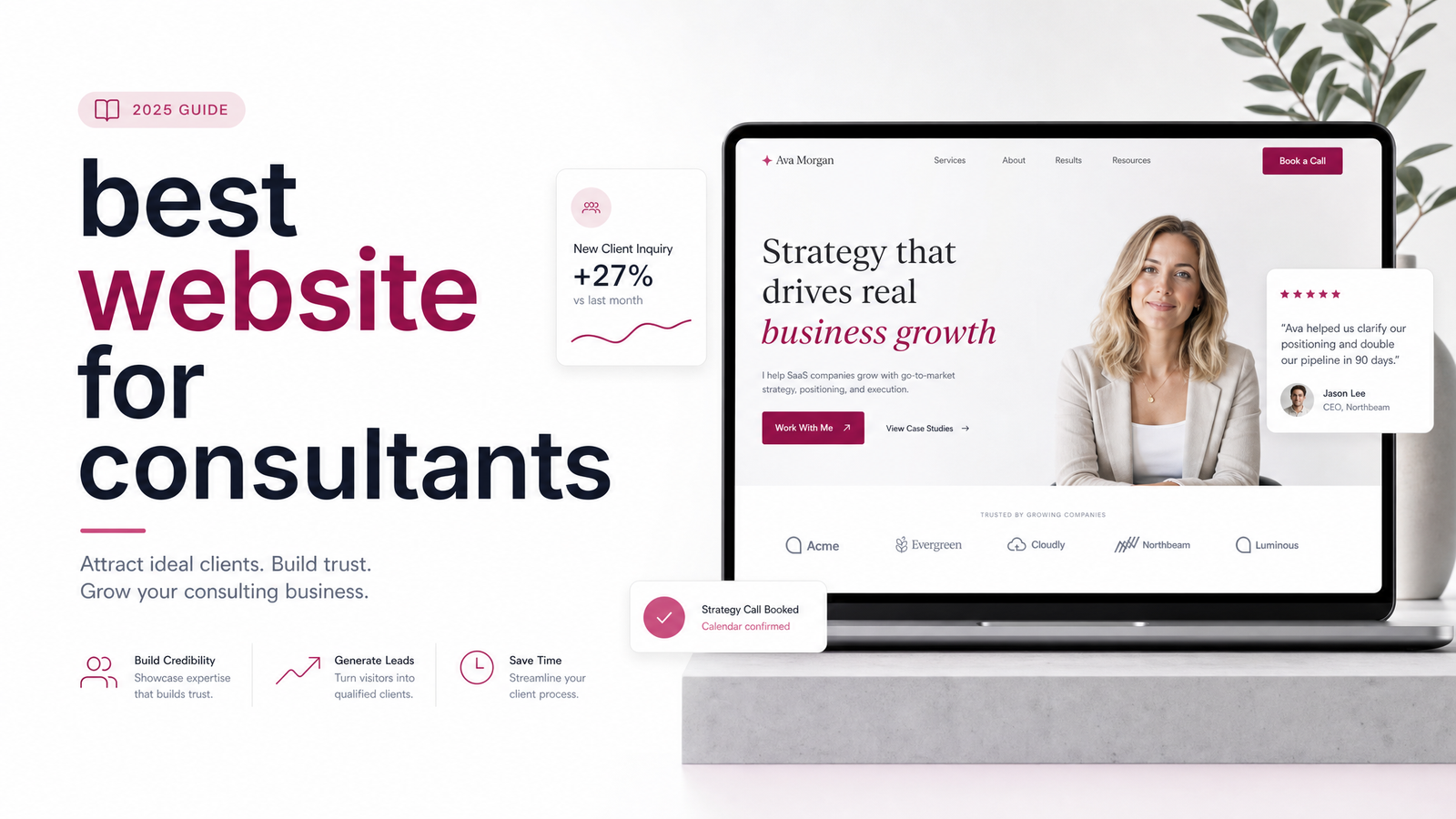
Most articles ranking for "best consulting website" show you a gallery of pretty homepages and call it a day. That's not useful if you're actually trying to get a site built. The real question is which path gets you a credible, lead-generating site with the least wasted time. This article treats "best" as a decision framework, not a mood board.
What "Best" Actually Means for a Consultant's Website
A consultant's website has one job: convert a stranger's visit into a booked discovery call. The best website for consultants isn't the one with the most animation or the trendiest font — it's the one that builds consultant website credibility fast, in the first eight seconds, before a prospect decides whether to trust you with their problem.
Credibility, for a consultant, looks different than for a product business. There's no cart to abandon, no SKU to compare. Visitors are evaluating you — your judgment, your track record, your fit for their situation. A site that's slow, generic, or vague about what you actually do fails that test even if it was built on the "best" platform. So the comparison here isn't builder-vs-builder — it's which route gets you to credibility plus conversion with the least cost in money, time, or opportunity cost against your billable hours.
The 4 Real Ways Consultants Get a Website (Compared)
Nearly every consultant ends up choosing one of four paths. Each has real trade-offs, not just marketing spin.
DIY website builders (Squarespace, Wix, Webflow, etc.) are the default first instinct. They're cheap monthly, and you control every pixel. But the best website builder for consultants is still a tool, not a strategist — it won't write your positioning, choose your photos, or fix a services page that reads like a job description instead of a value proposition. A genuinely polished DIY site typically eats 20-40 hours once you count learning the platform, writing copy, and second-guessing design choices.
Marketplace or theme templates speed up the visual layer but solve almost none of the strategy problem. You still have to write every word, adapt stock layouts to your actual services, and handle technical setup (domain, SSL, mobile performance). Templates are a shortcut to "looks fine," not to "converts."
Freelancers sit in the middle. A good freelancer vs website builder comparison usually comes down to skill variance and scope creep: some freelancers deliver excellent, strategic sites; others deliver a nice-looking shell with no copywriting input, leaving you to write your own value proposition. Freelance projects also tend to stretch in timeline and often skip ongoing maintenance, so the site quietly decays — outdated plugins, broken forms, aging testimonials.
Done-for-you services bundle strategy, copywriting, design, and technical setup into one outcome, usually with defined timelines and post-launch support. This is the only option engineered specifically for a consultant's actual constraint: billable hours are worth more than website-building hours. It removes the learning curve entirely — you provide input, someone else builds, tests, and maintains. Launchevra's websites for clinics, consultants and practices is built around exactly this trade-off, and pricing is structured as a packaged cost rather than an hourly freelance guess.
| Path | Time cost to you | Copy/design quality | Ongoing maintenance |
|---|---|---|---|
| DIY builder | High (20-40+ hrs) | Depends entirely on your skill | On you, indefinitely |
| Template | Medium | Generic unless heavily customized | On you, indefinitely |
| Freelancer | Medium (managing scope, revisions) | Variable, freelancer-dependent | Often not included |
| Done-for-you | Low (input only) | Consistent, strategy-led | Usually included |
The Non-Negotiable Checklist: What Every Best Consultant Site Needs
Whichever route you take — or if you're auditing a site you already have — the same checklist applies. These are the consultant website must-haves that separate a site that converts from one that just exists:
- A one-line value proposition above the fold that names who you help and what result you deliver, readable in under five seconds.
- A services page written around outcomes, not deliverables. "Reduce operating costs by 15%" beats "strategic consulting engagements" every time.
- Testimonials or case studies with specifics — names, industries, or numbers, not vague praise.
- One obvious call-to-action, ideally "book a call," repeated consistently rather than buried in a contact page. If booking friction is costing you leads, this online booking decision guide is worth a look.
- Fast mobile load times. A large share of first visits happen on a phone, often from a referral link or LinkedIn.
- Basic technical SEO — proper title tags, one clear H1, indexable pages — so you're findable for the searches your prospects actually run.
What makes a good consulting website isn't a longer feature list — it's that every one of these does its job without friction. If your site is missing two or more, it's not "good enough," regardless of how recently it was redesigned. For a deeper look at trust-building copy, see this framework for trust-first website copy, which applies directly to consultants even though it was written for clinics.
Which Option Is Right for You
The right path depends on where you are, not on which platform is objectively "best."
A brand-new solo consultant testing whether their offer has demand can reasonably start with a simple DIY builder or template — the goal at that stage is validation, not polish, and spending on a full build before you know your positioning is premature.
An established consultant who already has clients but suspects the website is quietly costing them leads is a different case. Here, the math flips: every week spent tweaking a DIY site is a week not spent billing, and a mediocre site actively repels referrals who Google you before a call. This is the profile done-for-you services are built for — a website for independent consultants who need the site to simply work, without becoming a side project. If you're unsure whether your current site belongs in this category, this 15-minute lead-generation diagnostic is a fast way to check.
A multi-person practice or firm has even less margin for a DIY experiment — multiple people need consistent messaging, and inconsistency reads as disorganization to prospects evaluating a firm rather than an individual. For these situations, the best platform for a consulting website is really the process behind it: one that combines strategy, copy, and design into a coordinated result rather than leaving each piece to chance.
Frequently Asked Questions
What is the best website builder specifically for consultants?
There's no single best builder — Squarespace, Wix, and Webflow are all capable, but the builder matters far less than the strategy and copy behind it. A well-built site on a mid-tier platform will consistently outperform a poorly written site on a "premium" one.
Do consultants really need a custom website, or is a template enough?
A template is enough for testing an idea, but not for converting serious prospects once you have real client work to show. Templates still require you to write strategic copy and customize layout to your services, which is where most DIY attempts fall short.
How much should a consultant expect to spend on a professional website?
Costs vary widely: DIY builders run $15-40/month plus your time, freelancers typically range from a few hundred to several thousand dollars depending on scope, and done-for-you services package strategy, copy, and design into a fixed cost. See Launchevra's pricing for a packaged example.
How long does it take to get a consultant website live?
A DIY build usually takes several weeks of part-time effort once you factor in learning the platform and writing copy. Freelance projects often run 4-8 weeks depending on revisions, while done-for-you services typically follow a fixed, faster timeline since the process is standardized.
Do I need a blog on my consulting website for SEO?
Not necessarily to start, but it helps if you want to rank for specific questions your prospects search. A blog is most valuable once your core pages — home, services, about, contact — are already solid and converting.
Should a consultant's website include pricing?
It depends on your model — flat-fee or productized consultants often benefit from showing starting prices to filter unqualified leads, while highly custom engagements can instead show a clear "book a call" path. Either way, ambiguity about the next step is worse than any pricing choice.
If you bill by the hour, the hours you'd spend learning a builder are the same hours a done-for-you build is designed to save. Explore websites for clinics, consultants and practices and pricing to see how Launchevra can get your site live without adding another project to your plate.
Originally published on Rankevra.