
Website Design & Marketing Systems for Contractors
26 September 2026
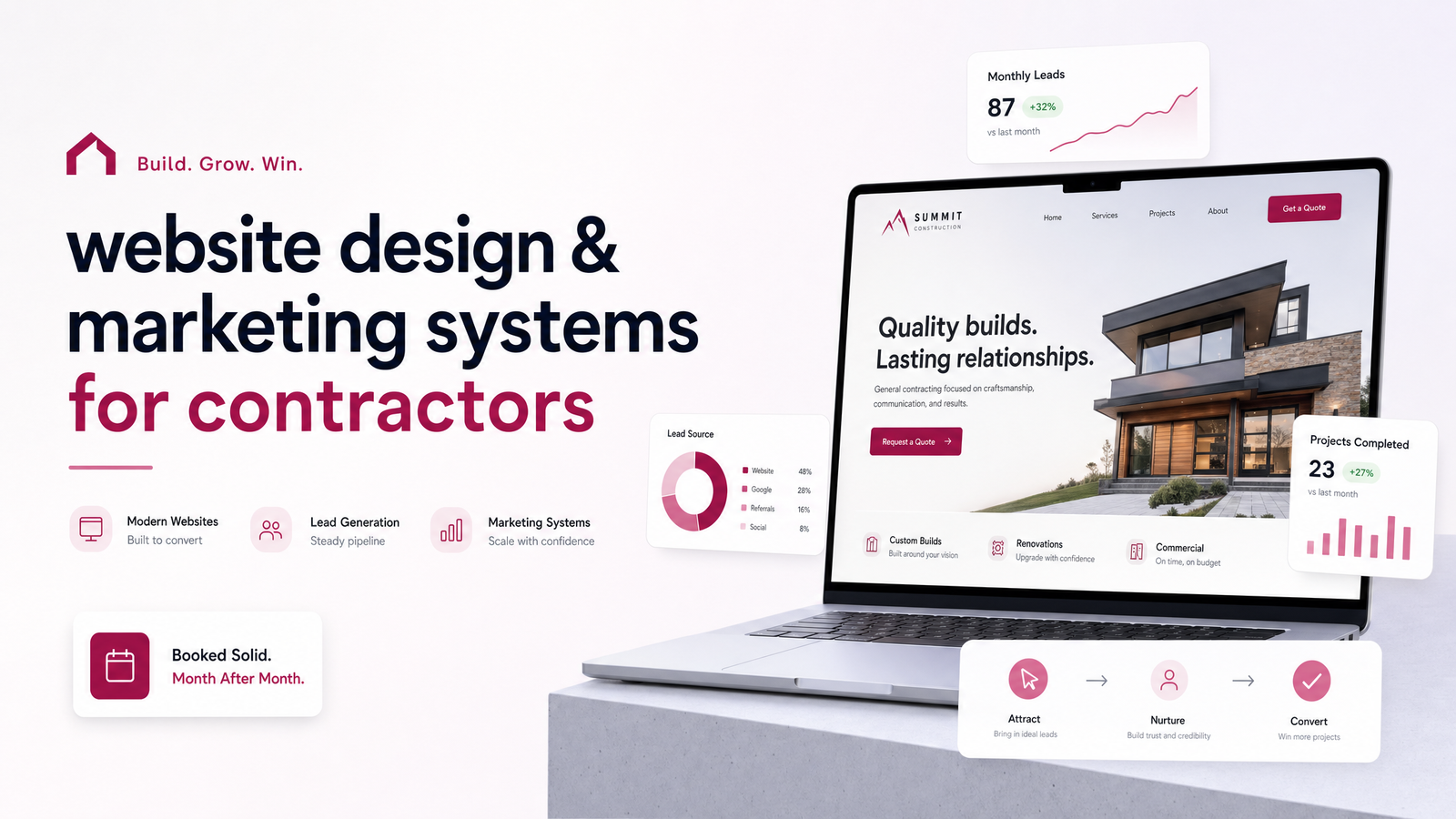
Why a Website Alone Isn't a Marketing System
Most contractors treat their website as a destination — a place people land and hopefully call. But a site is only one part of what books a job. Between "visitor arrives" and "job scheduled" sits a gap: the lead fills out a form, and then what? If nobody responds for six hours, reviews look thin, or Google can't find your service area page, that visitor never becomes a customer.
This is the core difference between a contractor website and a real marketing system. Website design and marketing systems for contractors aren't two separate purchases — they're one connected engine. The site captures attention and intent. Everything downstream — instant follow-up, automation, reviews, local search — determines whether that intent turns into a signed job. Treat them as separate projects and you'll keep paying for traffic that evaporates.
The 4 Parts of a Contractor Marketing System
A working system has four moving parts, and each one feeds the next:
- The website — the structure and speed that get someone to take action.
- Lead capture — the forms, click-to-call buttons, and chat that catch that action.
- Instant follow-up and automation — what happens the moment a lead comes in.
- Reviews and reputation — the loop that turns finished jobs into future visibility.
Skip any one piece and the whole chain weakens. A fast site with no follow-up automation still loses leads to the competitor who calls back in ten minutes. A great follow-up process with no reviews still struggles to rank locally. Contractor lead capture, automation, and review generation aren't add-ons — they're the mechanism that makes the website's traffic worth something.
The Website: Built to Convert, Not Just Look Good
Contractor website design has specific requirements generic business sites don't. You need dedicated service-area pages for every town you actually work in, real project photos instead of stock imagery, and mobile-first speed — most inbound calls happen from a phone in a driveway or job site, not a desktop. Calls-to-action need to be obvious and repeated, not buried on a single contact page. Websites for contractors and trades covers this build in more detail. For the tactical SEO checklist that supports these pages, see the related SEO Checklist for Local Small Business Websites.
Speed-to-Lead: The Make-or-Break Follow-Up Window
Here's where most contractor marketing quietly fails. Research from CustomerFlows found businesses responding within five minutes are 21 times more likely to qualify a lead — yet the average contractor response time sits at four to eight hours. Separate research from Pushleads puts the average closer to 42–47 minutes, with a measurable revenue gap between fast and slow responders either way. The takeaway: speed to lead isn't a nice-to-have, it's the deciding factor. A lead who fills out your form is actively comparing you to two or three other contractors right now. Automated text-back, instant chat replies, and real-time notifications close that window before a competitor does. This is contractor website automation doing the actual conversion work the pretty design gets credit for.
Reviews, Reputation, and the Local Search Loop
Reviews aren't just social proof — they're a ranking input. Google Business Profile visibility depends heavily on review volume, recency, and response rate, and a stronger local ranking sends more organic traffic back to the website, which then needs the same fast follow-up to convert. This is the loop: finish a job, request a review, the review strengthens local search, local search brings the next lead. Skip the request step and the loop breaks quietly — you keep doing good work, but fewer people find you. For the mechanics of setting up and optimizing your profile, see the Google Business Profile Setup Guide, and for broader local SEO tactics, Local SEO for Small Business Websites: Before & After Launch.
Why Contractors DIY This and Lose Leads Anyway
Most contractors don't lack effort — they lack a connected system. A common pattern: a site built on a DIY builder, a separate review app, a spreadsheet for tracking leads, and a phone checked between jobs. None of these tools talk to each other. A lead comes in through the form, sits in an inbox, and gets a callback three hours later — by which point conversion research from PipelineOn shows most of the conversion gap isn't about how a site looks, but what it functionally does once someone lands on it. That's the real cost of DIY contractor website problems: not bad design, but disconnected pieces and slow response, both of which quietly cap how many visitors ever become booked jobs. If you already have a site and are wondering whether it's salvageable or needs a rebuild, Website Redesign vs Rebuild: How to Know Which You Need walks through that decision.
What a Done-For-You System Looks Like
Launchevra builds website design and marketing systems for contractors as one project instead of stitching together separate vendors. That means the service-area pages, click-to-call and form capture, automated instant follow-up, and review request flow are built to work together from day one — not bolted on after the fact. A done-for-you contractor website built this way removes the design, copywriting, and technical setup from your plate entirely, so follow-up and review requests happen automatically instead of depending on you remembering between job sites. For contractors evaluating cost, How Much Does a Small Business Website Cost in 2026? breaks down realistic pricing ranges.
You can keep patching together a website builder, a review app, and a spreadsheet that don't talk to each other — or get the whole engine built and connected in one project. Visit Websites for contractors and trades to see how a full build comes together, or start with Launchevra to talk through what your business actually needs.
Frequently Asked Questions
What's the difference between a website and a marketing system for a contracting business?
A website is the intake point — where someone finds you and expresses interest. A marketing system adds lead capture, instant follow-up automation, and a review loop that feeds local search, turning that interest into booked jobs instead of unanswered form submissions.
Do I really need a CRM or automated follow-up if I already have a website?
Yes — without it, leads sit unanswered while competitors respond faster. Automated text-back and notifications close the response window immediately, which research shows dramatically increases the odds a lead actually becomes a booked job.
How fast should I respond to a new lead from my website?
Within five minutes if possible. Studies show responding in that window makes a lead up to 21 times more likely to qualify, while the average contractor takes anywhere from 42 minutes to several hours, losing leads to faster competitors in the meantime.
Can one website really handle multiple services and multiple towns for a contractor?
Yes, through dedicated service-area pages built for each town and service combination, rather than one generic page trying to cover everything. This structure helps both visitors and Google understand exactly where and what you do.
How much does it cost to set up a full website and marketing system for a contractor?
Costs vary based on scope, but a dedicated breakdown of realistic 2026 pricing ranges is available in this cost guide. A done-for-you build typically bundles site, capture, automation, and review setup into one project rather than separate line items.
Will a marketing system replace referrals and word-of-mouth for my contracting business?
No — it strengthens them. Reviews and reputation management amplify word-of-mouth by making it visible to people searching online, while faster follow-up ensures referred leads don't slip away before you respond.
Originally published on Rankevra.