
Website Design Contract Checklist for Small Business Owners
24 September 2026
The Deposit Isn't the Risk — The Missing Paperwork Is
Paying a website deposit isn't the dangerous part. Paying one against a vague quote, a text-message agreement, or a handshake deal is. Every year, small business owners hand over hundreds or thousands of dollars to a designer found through a referral or a Facebook ad, only to end up weeks later with no site, no refund, and no paperwork proving what was promised.
The fix isn't avoiding deposits — it's refusing to pay one before the right terms exist in writing. Treat this as a checklist to run through before you send money. If a website design contract is missing the details below, that's your signal to pause and get it in writing before your card leaves your wallet.
Quote vs. Contract: They're Not the Same Thing
A quote tells you what a website might cost. A contract tells you what happens if things go wrong — who owns what, what's included, and what recourse you have. Confusing the two is how small business owners end up paying before a contract exists, believing an emailed price estimate somehow protects them.
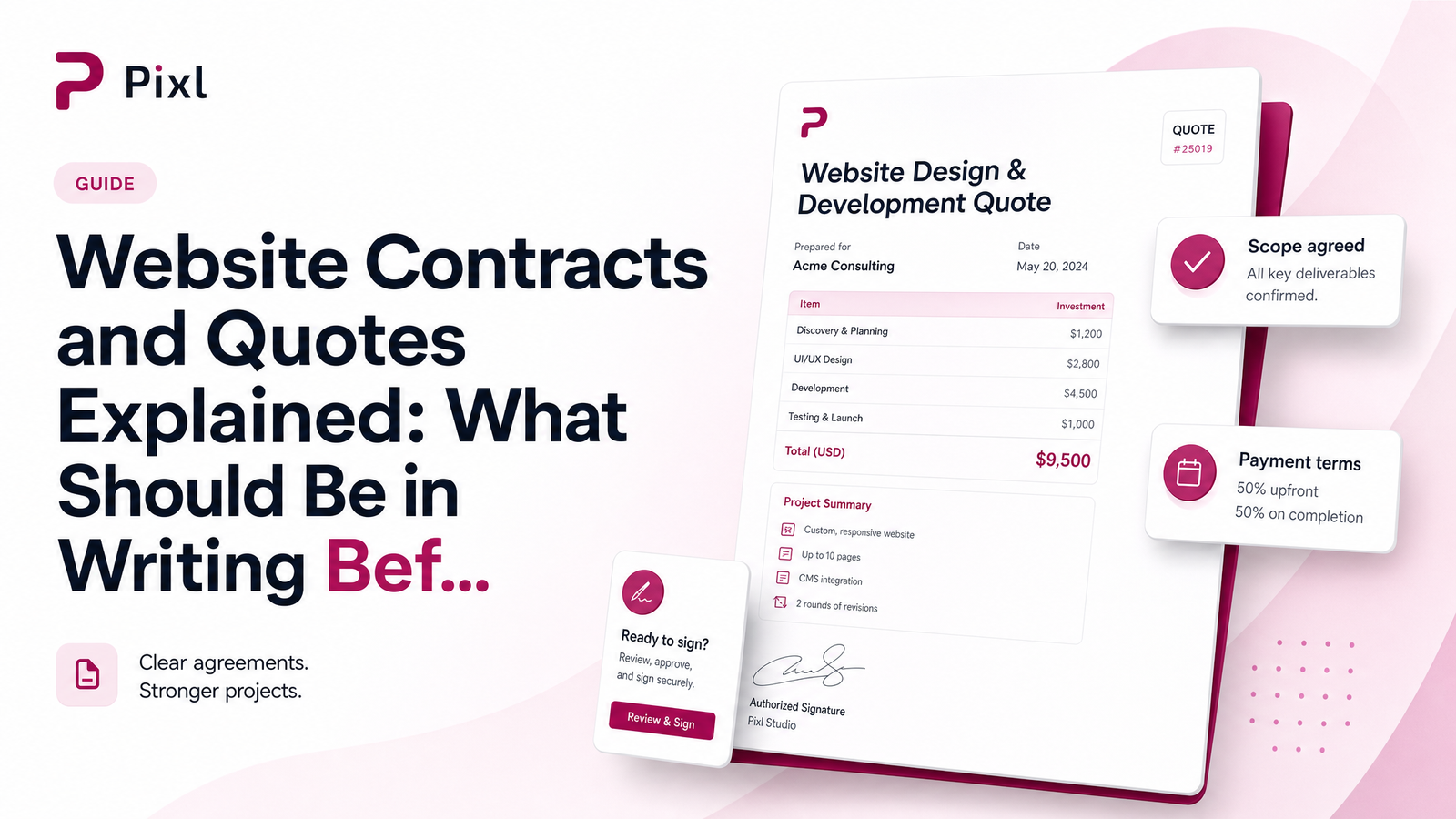
A website design quote should itemize pages, features, and rounds of revisions, and ideally reference or attach a fuller written agreement covering payment terms and ownership. For a deeper look at what a fair, itemized quote breaks down into, our pricing breakdown guide covers real cost ranges and inclusions for 2025 projects.
Here's the tell: a designer who sends a fast, cheap, one-line quote with no contract attached is often signaling one of two things — they haven't scoped the work properly, or they don't want anything enforceable on record. Neither is a good sign. A website contract vs. quote distinction matters most in the first disagreement, not the first conversation.
7 Things That Must Be in Writing Before You Pay
Before any deposit changes hands, get these in writing — ideally in a single signed document, not scattered across emails.
Exact scope of work. How many pages, what features (booking forms, e-commerce, blog), and — just as important — what's explicitly excluded. "Website design" means different things to different people; the scope should name every deliverable.
Total price and a milestone-based payment schedule. Payments should be tied to completed stages (design approval, development complete, launch) — not arbitrary calendar dates that arrive whether or not work has happened.
Deposit amount and refund terms. What percentage is due upfront, and what happens to it if the project doesn't happen — is any portion refundable, and under what conditions?
Revision rounds and what counts as "extra." Two rounds of homepage revisions is common; endless tweaking is not. The contract should define what a change order looks like once you're past the included rounds.
Timeline with responsibilities on both sides. Delivery dates matter less than who owes what and when — including deadlines for you to supply content, photos, or approvals.
Ownership and IP assignment. The contract should state, in plain terms, that full intellectual property rights — design, code, and content — transfer to you upon final payment. Without this clause, you may have paid for a website you don't legally own.
Termination and kill fee terms. What happens if either party wants out midway? A fair contract defines a kill fee or partial payment structure instead of leaving either side exposed to an all-or-nothing dispute.
Each of these clauses answers a specific "what if" — and if your quote can't answer them, it's not ready for a deposit.
Red Flags in a Website Quote or Contract
Some warning signs show up before you even reach the contract stage. Watch for:
- Verbal-only agreements — a phone call and a handshake, with pricing and scope never written down.
- No mention of who owns the domain or hosting account once the project ends.
- "Unlimited revisions" with no rounds defined — often a sign the scope itself was never nailed down.
- A deposit requested with no milestones attached — just "50% now, rest later," with no defined stages in between.
- No termination or exit clause — meaning if the relationship sours, you have no contractual path to reclaim your money or files.
- Pressure to pay same-day before you've had time to read anything closely.
These red flags don't automatically mean scam — plenty are just sloppy paperwork from otherwise well-meaning freelancers. But sloppy paperwork is exactly what turns a stalled project into a lost deposit.
What a Fair Deposit Looks Like
A reasonable website deposit typically falls between 30% and 50% of the total project cost, paid to secure your place in the designer's schedule and cover early design work. What separates a fair deposit from a risky one isn't the percentage — it's whether it's tied to a defined milestone schedule.
A healthy payment schedule might look like: deposit at signing, a second payment at design approval, and the final balance at launch — each tied to a deliverable you can see and approve, not just a date on the calendar. If a designer asks for the full balance upfront, or a deposit with no further structure specified, that's worth questioning before you agree.
Frequently Asked Questions
Is a website deposit refundable if I change my mind?
It depends entirely on what the contract says — deposits are not automatically refundable under general business practice. Some agreements refund a portion if work hasn't started; others treat the deposit as non-refundable once signed. This is why refund terms need to be spelled out in writing before you pay, not assumed afterward.
How much should a website deposit be for a small business site?
A common range is 30% to 50% of the total project cost, paid upfront to secure the work and begin design. The exact figure matters less than whether it's tied to a milestone-based payment schedule rather than a single lump sum with no further structure.
What happens if I pay a deposit and the designer disappears?
Without a written contract, your recourse is limited mostly to disputing the charge with your bank or payment processor. A proper contract with milestone payments and a termination clause limits your exposure by ensuring you're never paying far ahead of completed work.
Do I need a lawyer to review a website design contract?
Not necessarily for a small, standard project, but you should still read every clause and ask the designer to clarify anything unclear before signing. For larger contracts or six-figure custom builds, a quick legal review is a reasonable added safeguard.
What's the difference between a quote and a contract?
A quote is a price estimate for the work; a contract is the enforceable agreement covering payment terms, ownership, and what happens if something goes wrong. A quote alone gives you no legal protection if the project stalls or scope disputes arise.
Who owns the website if there's no written contract?
Ownership can default to the designer under "work made for hire" principles unless a contract explicitly assigns intellectual property rights to you. This means you could pay in full and still not legally own the code, design files, or content without a clear IP assignment clause.
Launchevra builds every project on a written scope, a fixed quote, and a contract that spells out revisions, milestones, and full ownership transfer before any deposit is collected. See a sample project structure and transparent pricing, or reach out through Launchevra to start a project with the paperwork settled upfront, not after.
Originally published on Rankevra.