
How Long Does It Take to Build a Website in 2026?
19 September 2026
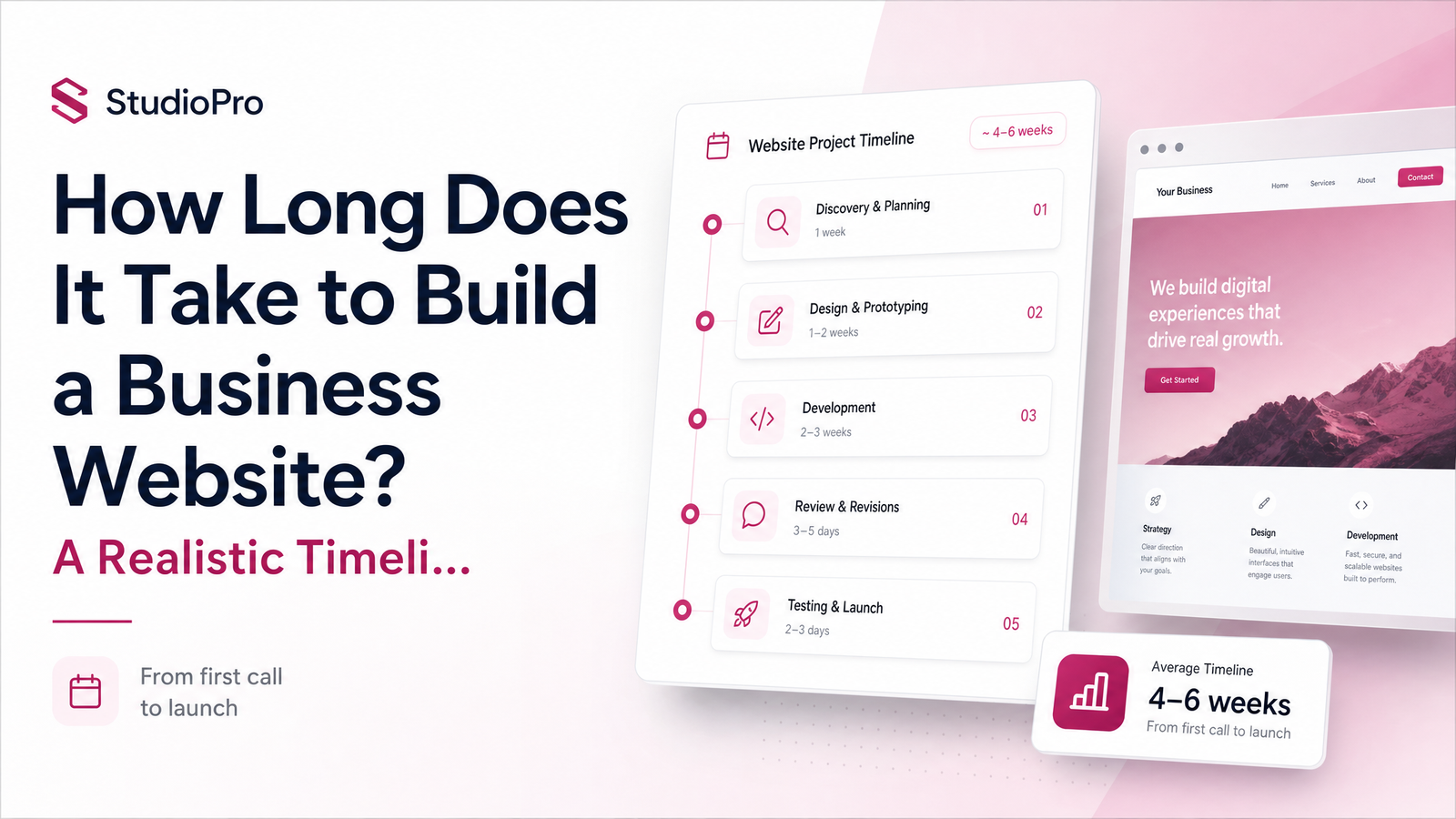
So, How Long Does It Actually Take?
For most small business sites, the honest answer is 2 to 8 weeks from the first call to going live. Industry benchmarks generally land in a wider 6-12 week window when planning and development for larger builds are included (Blacksmith Agency), but a straightforward brochure-style site for a contractor, clinic, or consultant usually moves faster.
The truth most "it depends" articles skip: the timeline depends on you almost as much as on the person building it. A designer can turn around a mockup in days — what stretches a 3-week project into a 3-month one is almost always what happens on the client side between stages. Keep that in mind as you read the breakdown below.
The 5 Stages From First Call to Launch
Every legitimate website design process, whether a solo freelancer or a full agency, moves through the same five stages. Here's what each realistically takes for a small business site.
| Stage | What Happens | Typical Time |
|---|---|---|
| 1. Discovery call | Goals, pages needed, sitemap, competitors, brand direction | 1 day - 3 days |
| 2. Content & asset collection | Photos, logo, copy, service descriptions, testimonials gathered | 3 days - 3 weeks (biggest variable) |
| 3. Design mockup | Wireframes and visual design for key pages built and shared | 3-7 business days |
| 4. Build & revisions | Full site built, revision rounds completed | 1-2 weeks |
| 5. Testing & launch | QA, mobile/browser checks, domain and hosting setup, DNS propagation, go-live | 2-5 days |
Discovery call. A 30-60 minute conversation covering your business, pages, and a rough sitemap. Rarely takes more than a day or two to schedule and complete.
Content collection. This is where most timelines are actually decided. If you already have your logo, photos, and copy, this stage can close in days. Starting from a blank page can stretch it to weeks — not from slowness, but because writing service descriptions and sourcing decent photos takes real time.
Design mockup. Once content is in hand, a designer can usually produce a homepage mockup or wireframe set within a week — the fastest, most predictable stage of the process.
Build & revisions. The site gets built across all pages, then you review it. Two structured revision rounds is standard; more than that usually signals scope creep rather than genuine fixes.
Testing & launch. Domain and hosting setup, DNS propagation (a few hours to 48 hours to fully resolve), and a final QA pass across devices close out the project.
What Actually Slows a Website Project Down
Nine times out of ten, delays aren't the designer's fault — they're the client's, and that's just how these projects work. Research on real-world web projects consistently points to the same bottlenecks (Ulement; dwellTEK):
- Missing content. Waiting on photos, bios, or service copy is the number one cause of stalled timelines.
- Too many approvers. When three or four people must sign off on every page, feedback crawls. One clear decision-maker moves projects dramatically faster.
- Scope creep. Adding new pages, features, or "just one more thing" mid-build resets the clock.
- Slow feedback loops. A two-day revision round stretches to two weeks if nobody replies to the email.
If you've ever wondered "why is my website taking so long," it's rarely the build itself — it's almost always one of these four buckets. The fix is usually just naming the bottleneck and clearing it.
DIY vs. Freelancer vs. Agency vs. Done-For-You: Timeline Compared
Here's how the major paths compare purely on speed — cost is covered separately in our Web Design for Small Business: 5 Paths Compared (2026) and cost breakdown articles.
| Path | Typical Timeline | Main Time Risk |
|---|---|---|
| DIY builder (Wix/Squarespace) | 1 day - several months | Entirely dependent on your own time and learning curve |
| Freelancer | 2-6 weeks | Availability, revision turnaround, single point of failure |
| Agency | 4-12+ weeks | Layers of process, multiple stakeholders on both sides |
| Done-for-you service | 2-4 weeks | Mostly bound by how fast you supply content |
DIY builders can technically go live in a day, but "how long to build a website yourself" really means "how long until you're happy with it" — a number that balloons once you're doing design, copywriting, and troubleshooting solo, often stretching into months. The freelancer vs agency question usually comes down to overhead: freelancers are faster but riskier if juggling other clients; agencies are more structured but slower by design (Elementor). Done-for-you services aim to combine agency-level structure with freelancer-level speed by keeping the process lean and content-driven from day one.
How to Get Your Website Live Faster
If you want to speed up your launch timeline, the levers are almost entirely in your hands:
- Gather your assets before the first call. Logo files, photos, and rough copy drafts remove the single biggest bottleneck before it starts.
- Appoint one decision-maker. One person approving pages beats a committee every time.
- Turn revision rounds around within 48 hours. Momentum matters — a stalled feedback loop is the easiest way to lose a week.
- Resist scope additions mid-project. Save new ideas for a phase two.
A simple prep checklist — logo, photos, page copy, one approver, a launch date in mind — solves most of the delay problem before it exists. Our Website Launch Checklist walks through exactly what to have ready before you go live.
Launch Isn't the Finish Line
Going live is a milestone, not the end. What happens after launch — updates, security patches, content refreshes, performance checks — matters just as much for keeping the site working for your business. Our guide to what's included in a website care plan breaks down what ongoing maintenance typically involves and what it costs.
Frequently Asked Questions
Can a website really be built in a week?
Yes, for a simple single-page or brochure site, if all content, photos, and copy are ready before work starts. Without prepared content, even a simple site typically takes two to three weeks because content collection becomes the bottleneck.
What's the single biggest thing that slows down a website project?
Missing or delayed content — photos, copy, logos — is the most common cause, closely followed by slow client feedback on revisions. Both are within the business owner's control and solvable with preparation before the project starts.
Do I need to have my content ready before I contact a web designer?
No, but having it ready significantly shortens your timeline. Many done-for-you services can help write copy and source images, but that added step adds time, so gathering what you can beforehand is the fastest path to launch.
How long does it take with a page builder like Wix or Squarespace versus hiring someone?
A DIY builder can go live in a day but typically takes weeks to months to reach a polished result once you factor in learning the tool, writing copy, and design decisions. A freelancer or done-for-you service usually delivers a finished, professional site in two to six weeks with far less of your own time invested.
Does a faster timeline mean lower quality?
Not necessarily — speed usually comes from a streamlined process and prepared content, not cut corners. The real quality risk comes from rushed testing or skipped revision rounds, not from an efficient workflow.
How long does it take to build a website that includes online booking or e-commerce?
Adding booking or e-commerce functionality typically adds one to three weeks beyond a standard brochure site, depending on how many products or services need configuring. Payment integration and testing account for most of that extra time.
Ready to know your exact timeline instead of a general estimate? Book a free discovery call with Launchevra and find out precisely how fast your site can go live — or browse pricing to see how the done-for-you process works.
Originally published on Rankevra.