
Free Privacy Policy Generator: Is It Enough for Your Site?
21 September 2026
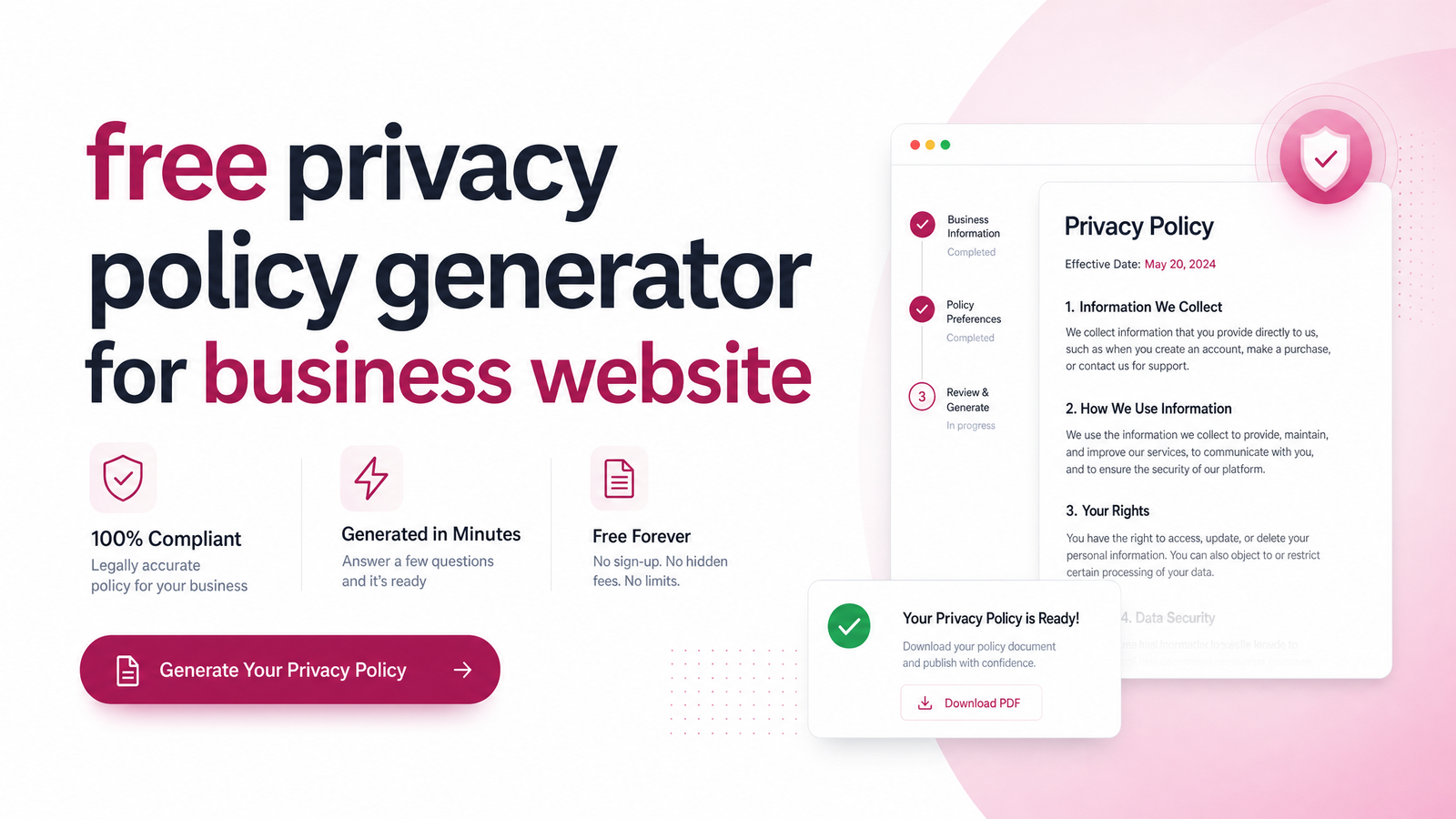
Yes, a free privacy policy generator for business website use can produce a legally functional starting policy — but only if what it spits out actually matches what your site does. Most don't, once you add booking forms, payment processors, or an email list. Here's the honest breakdown, without the upsell.
Do You Actually Need a Privacy Policy on Your Business Website?
If your site has a contact form, runs Google Analytics, or drops a single cookie, the answer is yes. Under GDPR, any site accessible by EU visitors and collecting personal data needs one. CCPA/CPRA extends similar obligations to businesses serving California residents above certain thresholds, and CalOPPA has required a posted privacy policy for California-facing commercial websites for years — well before GDPR made headlines. COPPA adds a separate layer if your site could reasonably be used by children under 13.
You don't need to be a multinational company for this to apply. A one-location contractor with a booking widget and Google Analytics is already collecting personal data covered by multiple laws. The privacy policy legal requirement for small business owners isn't hypothetical — it's the baseline cost of running a modern website, in the same category as having a working contact page. Platforms like Squarespace, Shopify, and WordPress plugin ecosystems assume you'll have one; some won't let you launch checkout flows without it.
What a Free Privacy Policy Generator Actually Does
Understanding how privacy policy generators work removes a lot of the mystery. You answer a short questionnaire: What kind of business is this? Do you use analytics? Do you collect emails? Do you process payments? Do you use cookies for advertising? The tool matches your answers against pre-written clause blocks and assembles a document.
Tools like Termly, iubenda, TermsFeed, and CookieYes all follow this same basic model — free tier included. A free privacy policy generator for business website use is genuinely useful for the boilerplate: data controller identification, general categories of information collected, standard user rights language, contact information for privacy requests. What's automated is the legal phrasing. What still requires your input is accuracy — the tool only knows what you tell it, and it has no way of checking that your answers match what your site's code is actually doing.
Where Free Generators Fall Short
The gaps are consistent across most free-tier tools, and they're worth knowing before you hit publish.
Free plans often add visible branding or a watermark referencing the generator itself, which reads as slightly unprofessional on a client-facing site. More importantly, they don't auto-update when laws change — a paid subscription usually buys you notifications and revisions when GDPR guidance shifts or a new state privacy law passes, while free versions leave you responsible for noticing and editing yourself.
The bigger problem is specificity. Generic templates describe categories ("we may use third-party service providers") instead of naming the actual tools running on your site — your booking software, your payment processor, your email marketing platform. If a regulator or a customer ever asks what "third-party service providers" means in practice, a vague clause doesn't hold up as well as one that names Stripe, Calendly, or Mailchimp directly. And most free tiers only handle one regulatory framework cleanly; asking a single free document to cover GDPR CCPA privacy policy small business needs simultaneously, with the differences in consumer rights language each requires, is where templates get thin.
A Practical Checklist Before You Publish a Generated Policy
Before you copy any generated privacy policy template for small business website use onto your live site, run through this:
- List every tool that touches visitor data — form plugin, analytics, booking system, payment processor, email platform, live chat widget, ad pixels.
- Match each one to a disclosure in the policy. If a tool isn't mentioned, the policy is incomplete for your actual site.
- Add a real, monitored contact method for privacy requests — not a placeholder email that nobody checks.
- Set a review reminder — every 6–12 months, or immediately after adding a new tool or integration.
- Strip unused boilerplate. If you don't run ads or sell data, remove clauses implying you might; irrelevant sections create confusion, not protection.
This is the difference between a policy that's technically present and one that's actually accurate — and accuracy is what matters if anyone ever checks.
When a Generic Generator Isn't Enough Anymore
A free generator is a reasonable choice for a pre-launch or hobby site with no real data collection beyond basic analytics. The calculation changes at specific trigger points.
Adding online booking is one of the biggest. A privacy policy for a booking website needs to account for names, contact details, appointment history, and sometimes payment information, all held by a third-party scheduling tool with its own data practices. If you're deciding whether booking software makes sense for your business at all, Online Booking for Service Businesses: A Decision Guide is worth reading before you build the disclosure around it.
E-commerce or payment processing is another line: you're now handling financial data under stricter expectations. So is building an email list — marketing consent rules under GDPR and CAN-SPAM aren't identical to basic data-collection disclosures. And if you serve clients across multiple states or countries, you're likely triggering more than one regulatory framework at once, which is exactly where free single-law templates struggle.
None of this necessarily means hiring a lawyer. It means the policy needs to be rebuilt around your actual stack, not a generic checklist. When to hire a lawyer for privacy policy work specifically makes sense once you're processing sensitive data (health, financial, biometric) or operating in a heavily regulated niche — for most local service businesses, precise, tool-matched documentation solves the problem without legal fees.
How LaunchEvra Handles Legal Pages When We Build Your Site
We build the site, so we already know exactly which forms, analytics tags, booking widgets, and payment integrations are running on it — the legal pages get written to match reality rather than bolted on afterward as an afterthought. That's the practical advantage of website legal pages done for you as part of the build, instead of a generic document dropped in during launch week.
You can see what a full build looks like, legal pages included, in Small Business Website Agency: What to Expect & How to, and review our own Privacy Policy as a real example of what a maintained, tool-specific policy reads like. Full scope and what's included at each tier is on the Pricing page.
A free generator is a perfectly fine way to get a hobby site or pre-launch page legally covered. But the moment you're taking bookings, processing payments, or growing an email list, your policy needs to track your actual tech stack — and that's precisely what gets missed when it's added as a last-minute afterthought instead of part of the build. If you'd rather have it handled correctly from day one, Launchevra builds it in from the start.
Frequently Asked Questions
Is a free privacy policy generator actually legal to use for my business website?
Yes — there's no rule against generating your own policy rather than paying a lawyer. The risk isn't in using the tool; it's in publishing a policy that doesn't accurately describe what your site actually collects and shares.
Do I need a privacy policy if my website only has a contact form?
Yes. A contact form collects personal data (name, email, message content), enough to trigger disclosure requirements under GDPR, CCPA/CPRA, and CalOPPA depending on your visitors' location. Even a single-field contact form needs a basic policy explaining what happens to that information.
What's the difference between a free and paid privacy policy generator?
Paid plans typically remove generator branding, add automatic updates when laws change, and offer broader multi-law coverage (handling GDPR and CCPA together, for example) plus cookie consent banner integration. Free tiers cover the basics but leave monitoring and updates entirely up to you.
Can I just copy a privacy policy from another website?
No — copying another business's privacy policy is risky because it describes their tools and data practices, not yours, and it may be copyrighted. A mismatched policy can be worse than none at all, since it creates a written record of disclosures your site doesn't actually honor.
How often do I need to update my privacy policy?
Update it any time you add a new tool that touches visitor data — booking software, a new payment processor, an email platform — and review it at least every 6–12 months even without changes, since privacy laws are revised regularly. Responsibility for tracking this sits with the business owner, not the generator.
Does a free generator cover GDPR and CCPA at the same time?
Sometimes, but coverage is often shallow compared to paid plans. Many free tiers are built around one primary framework, so if you have both EU and California visitors, check carefully whether the generated policy addresses both sets of consumer rights or just one.
Originally published on Rankevra.